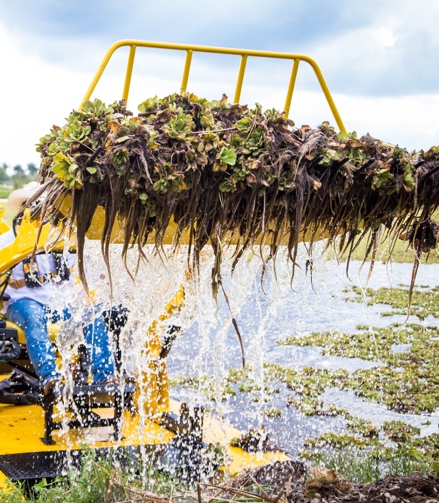
As waterway managers plan for the season ahead, one question keeps surfacing: how to control aquatic weeds quickly, safely, and sustainably. While chemical herbicides remain common, scientific and government research increasingly points to mechanical harvesting as a faster and more environmentally responsible solution.
Immediate Results Matter
Mechanical harvesting physically cuts and removes aquatic vegetation from the water. According to research from the U.S. Army Corps of Engineers, this approach provides immediate relief in navigation channels, swim areas, and high-use waterways — unlike herbicides, which can take days or weeks to show results and leave vegetation in place while it dies and decomposes.
Removing Weeds — and the Nutrients They Carry
Government and lake management studies show that mechanical harvesting does more than clear space. By removing plant biomass entirely, it also removes nutrients like nitrogen and phosphorus that would otherwise be released back into the water during decomposition. This helps reduce conditions that contribute to algal blooms and declining water quality.
Reliable, Targeted, and Chemical-Free
Unlike chemical treatments, mechanical harvesting does not depend on water chemistry, temperature, or plant uptake. NOAA and state ecology agencies recognize mechanical methods as reliable tools for targeted control, especially in areas where safety, public access, and environmental sensitivity are priorities.
Just as important, mechanical harvesting avoids introducing chemicals into waterways — reducing risk to people, pets, wildlife, and downstream ecosystems, and eliminating post-treatment water-use restrictions often associated with herbicides.
A Smarter Start to the Season
While every waterbody is different, many agencies now favor mechanical harvesting as a primary strategy, using chemicals only when access or conditions require it. Planning ahead in January allows managers to prioritize solutions that deliver immediate results, predictable performance, and long-term water quality benefits.